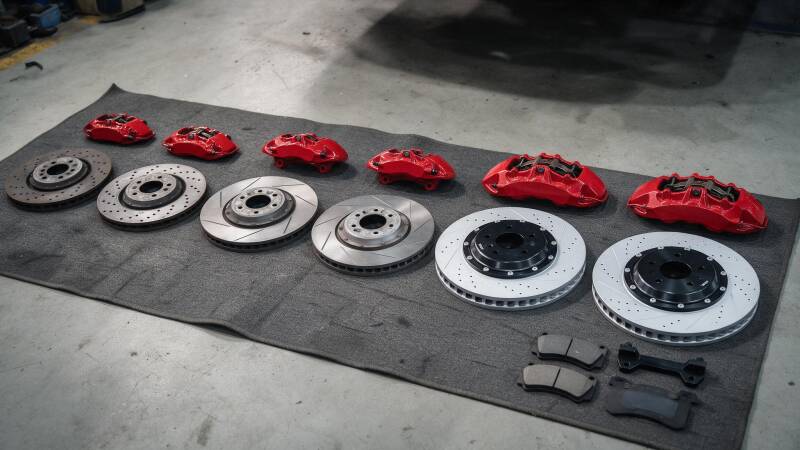
Have you ever wondered whether upgrading from 4-pot to 6-pot brakes will give you a better brake pedal?
A 6-pot caliper may sound like an obvious upgrade. However, more pistons do not automatically mean a firmer pedal or a better-matched braking system. When comparing brake upgrades, it is important to look beyond the number of pistons and consider how the complete system works together.
At Auto Point Plus, we look at the whole braking system—not just the calipers—to help identify the cause of a soft pedal, excessive pedal travel or concerns following a brake upgrade.
What Is the Difference Between 4-Pot and 6-Pot Brakes?
The term “pot” refers to a piston inside the brake caliper. A 4-pot caliper has four pistons, while a 6-pot caliper has six.
A 6-pot caliper can offer improved brake-pad support and heat management for demanding driving. However, piston count alone does not tell you how the brake pedal will feel.
The key consideration is compatibility: the calipers, master cylinder and pedal ratio need to work together.
Why Total Piston Area Matters
When comparing calipers, the total piston area matters more than simply counting the pistons.
If replacement calipers require more brake-fluid volume than the original setup, the existing master cylinder may need more pedal travel to meet that requirement. This can result in a longer brake pedal, even after fitting what appears to be an upgraded set of calipers.
That is why a move from 4-pot to 6-pot brakes should be assessed as a system change rather than a simple component swap. Master-cylinder size needs to suit the caliper piston area and pedal ratio.
What Can Cause a Soft or Long Brake Pedal?
A soft pedal or excessive pedal travel should not automatically be blamed on the number of caliper pistons. Several issues may contribute, including:
-
Air remaining in the hydraulic system.
-
An incorrect or incomplete bleeding procedure.
-
Calipers installed with the bleed nipples in the wrong position.
-
Flexible brake hoses expanding under pressure.
-
Brake-fluid leakage.
-
Excessive clearance between the brake pads and discs.
-
A mismatch between the calipers and master cylinder.
Because there are several possible causes, identifying the problem requires more than choosing a different caliper or replacing the master cylinder.
Will a Larger Master Cylinder Fix the Problem?
A larger master-cylinder bore moves more brake fluid for a given amount of piston travel. This generally reduces pedal travel, but it can also increase the effort needed to press the brake pedal.
In other words, a shorter pedal is not automatically a better pedal.
The aim is to achieve the right balance between fluid movement, pedal travel and pedal effort. Fitting the largest master cylinder available is not a substitute for correctly matching the braking components.
Brake-System Inspections at Auto Point Plus
Whether you are considering a brake upgrade or investigating a soft or long brake pedal, the complete system deserves attention.
At Auto Point Plus, we inspect the calipers, master cylinder, brake fluid, hoses, pads and rotors. Our approach considers how these components work together rather than focusing on piston count alone.
Contact Auto Point Plus to book a professional brake-system inspection and discuss your braking concerns.
Add comment
Comments